Beijing
Peking Duck
The dish that engineers a bird — air-dried skin, mahogany glaze, three courses from one duck.
In repertoire since Feb 2026
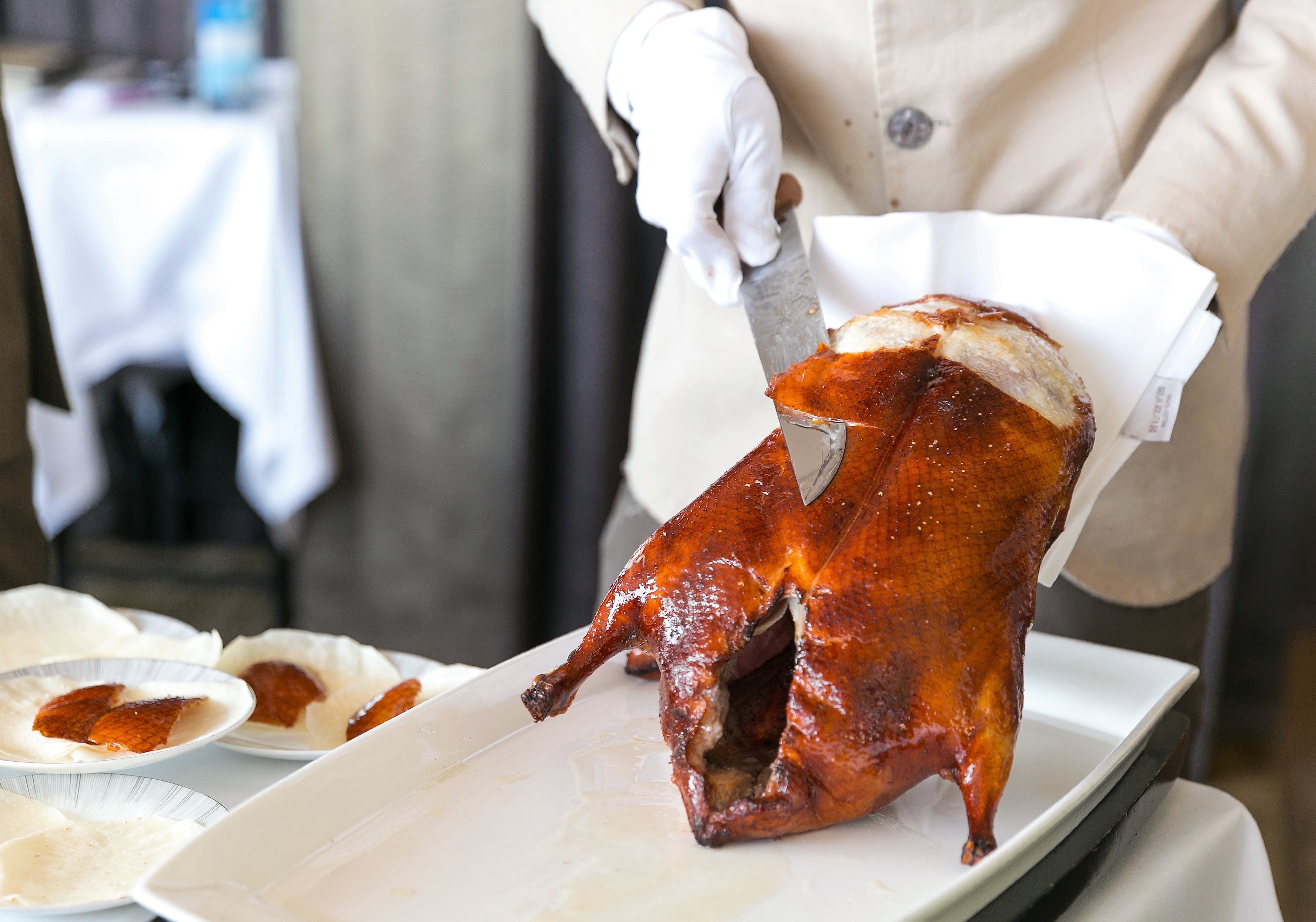
Skin is the point.
Every step in the classical preparation — inflating the duck to separate skin from meat, blanching with boiling water to tighten the skin, glazing with maltose, hanging in a cool dry room for a day — is engineered for one outcome: skin that shatters when you bite it. The meat is incidental. The skin is the dish.
2 · Plant
Then, the plants.
Each ingredient held water and minerals, built sugar out of light over weeks or months, ripened, and was picked. A few ingredients (salt, water) came from a different elemental story.
- Ingredient
Whole duck
1 whole Pekin duck, 2.2–2.5 kg, with head and feet on if possible
Ask the butcher to leave the head and a flap of neck — they help suspend the bird during drying.
Origin not yet authored
- Ingredient
Maltose syrup
3 tbsp maltose syrup (or honey)
Maltose gives the deeper mahogany glaze; honey works but the colour is lighter.
Origin not yet authored
- Ingredient
Rice vinegar
3 tbsp rice vinegar
Origin not yet authored
- Ingredient
Shaoxing wine
2 tbsp Shaoxing wine
Origin not yet authored
- Ingredient
Five-spice
1 tsp Chinese five-spice
Origin not yet authored
- Ingredient
Spring onions
1 bunch spring onions, white parts crushed (for the cavity), greens julienned (for serving)
Origin not yet authored
- Ingredient
Ginger
Thumb of ginger, crushed (for the cavity)
Origin not yet authored
- Ingredient
Cucumber
1 small cucumber, julienned
Origin not yet authored
- Ingredient
Mandarin pancakes
24 Mandarin pancakes (thin steamed wheat pancakes)
Buy frozen from an Asian grocer; steam to thaw.
Origin not yet authored
- Ingredient
Hoisin sauce
120 ml hoisin sauce
Origin not yet authored
3 · Cook
Then, the kitchen.
Heat, time, salt, fat, acid — the recipe that turns the ingredients into something more than their sum.
4 · Plate
Beijing
Peking Duck
The dish that engineers a bird — air-dried skin, mahogany glaze, three courses from one duck.
A dish older than the city it’s named after. Roast duck cooked this way appears in cookbooks from the Yuan dynasty (14th century); by the Ming the technique had moved to Beijing, and by the Qing it was a court dish. Quanjude — the restaurant that more than any other defines modern Peking duck — opened in 1864 and still uses ovens built to the original design.
The home version is an exercise in approximation. You will not get the inflated skin or the fruit-wood smoke or the carving theatre. What you can get, with patience and a fan, is the crackle.
Three courses, one duck.
Skin first, brushed with sugar and eaten on its own — that's what people line up for at Quanjude. Meat second, rolled in pancakes with hoisin, spring onion, and cucumber. Bones third, simmered into a soup that turns milky-white and tastes nothing like the bird you remember roasting.