Edo (Tokyo), Japan
Unadon
Grilled freshwater eel glazed with sweet-soy *tare*, served over rice in a lacquer box — Japan's summer-stamina dish, eaten on the Day of the Ox.
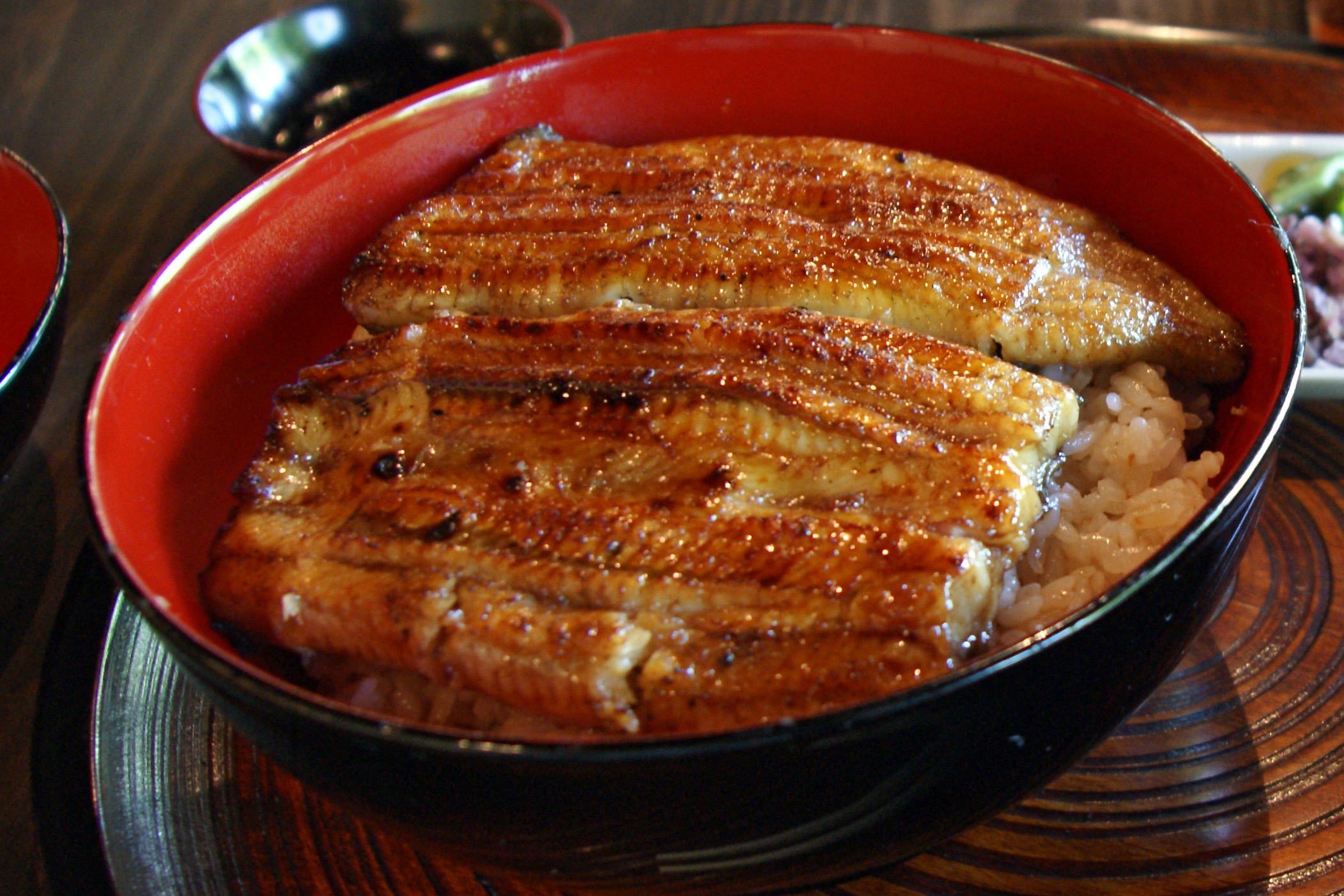
Steam then grill.
The Kanto (Tokyo) method butterflies the eel from the back, steams it for 20 minutes to render fat and tenderise the flesh, then grills it over charcoal while basting with *tare* (a sweet-soy reduction). The Kansai (Osaka) method skips the steaming, butterflying from the belly and grilling directly. Kanto unagi is melt-soft; Kansai unagi has a firmer bite with more char. Both are correct.
4 · Plate
Edo (Tokyo), Japan
Unadon
Grilled freshwater eel glazed with sweet-soy *tare*, served over rice in a lacquer box — Japan's summer-stamina dish, eaten on the Day of the Ox.
A summer-heat dish in a country famously without air conditioning until the 20th century. The Edo-period belief — promoted by 18th-century scholar Hiraga Gennai as a marketing campaign for an eel-restaurant friend — that eating unagi on the Day of the Ox protected against summer fatigue stuck so well that the tradition is still alive in modern Japan. Demand on that single day overwhelms the supply chain; supermarkets stock pre-grilled fillets and the fishmongers run double shifts.
The conservation context is sobering. Japanese unagi (Anguilla japonica) was classified endangered by the IUCN in 2014; wild stocks have collapsed under fishing pressure and habitat loss in the eels’ Sargasso-Sea-and-East-Asia migration route. Almost all restaurant unagi is now farmed from wild-caught glass eels (the closed life cycle has not been commercialised). The dish is loved; the supply chain is fragile.
Sansho for the finish.
A small sprinkle of *sanshō* — Japanese mountain pepper — over the eel before eating. The citrus-numbing note cuts the richness of the eel and the sweetness of the tare. The kitchen rarely adds it; the eater controls the dose.